Place
Dates and hours
Artists
Curator
On viewGroup exhibition
Not Just Memory: Khalil Raad and the Contemporary Gaze
Press release
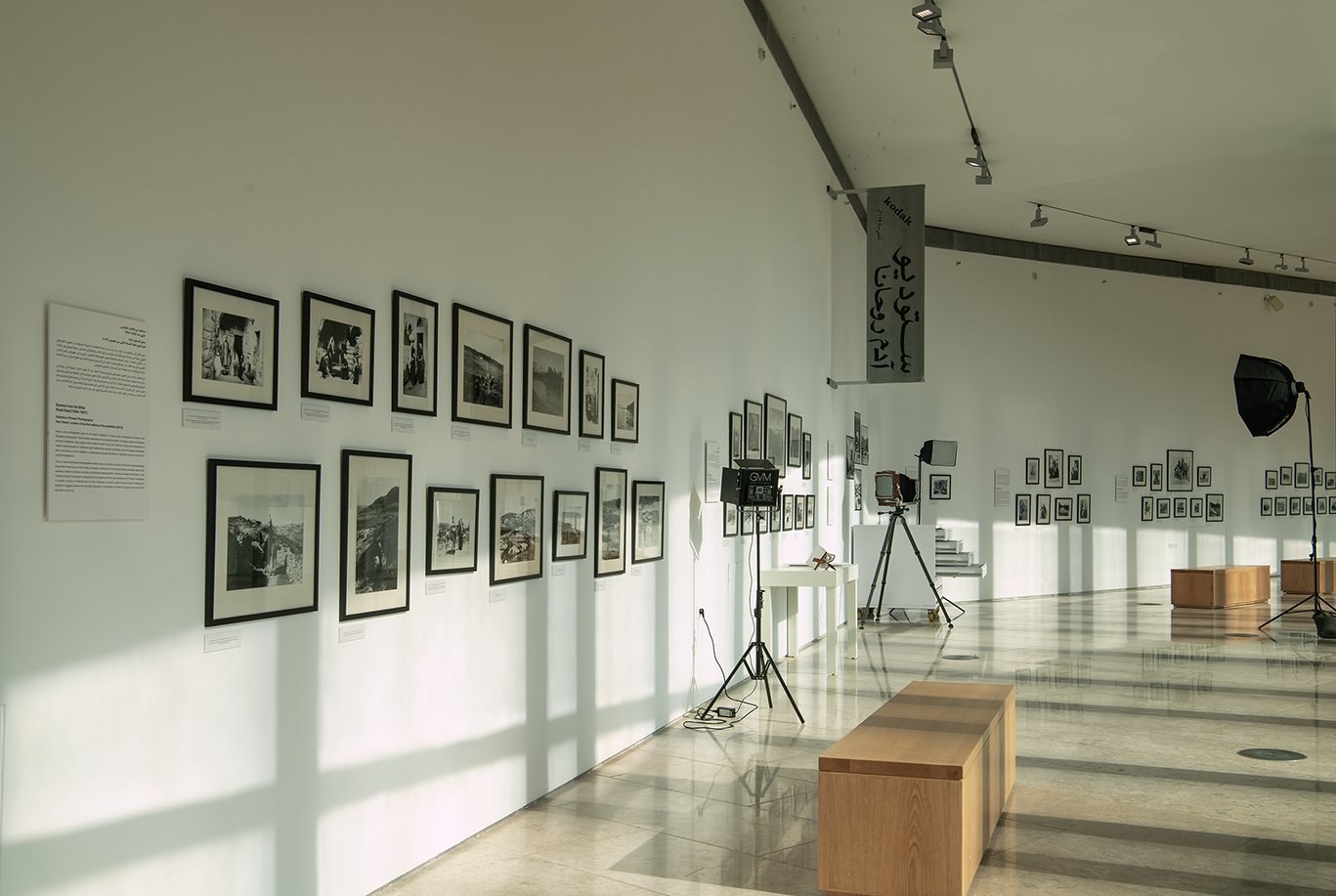
Not Just Memory: Khalil Raad and the Contemporary Gaze, presented by the Palestinian Museum with the Institute for Palestine Studies (IPS), opened on 17 September 2025 in the museum's glass gallery and remains listed among the museum's current exhibitions. It revisits a landmark exhibition that IPS devoted to the pioneering photographer twelve years earlier, originally curated by Vera Tamari, in a new presentation curated by Nadi Abusaada.
Khalil Raad (1854 to 1957), often described as Palestine's first Arab photographer, opened his studio on Jaffa Road in Jerusalem in 1890. His archive, rescued in 1948 and now held by IPS, runs from the late nineteenth century to the 1940s, spanning the last Ottoman decades, the British Mandate and accelerating Zionist settlement. His early images drew on Western "Holy Land" conventions, but his practice turned increasingly to everyday Palestinian life: farming, markets, seasonal celebrations, political demonstrations, and coastal and urban scenes.
The exhibition treats photography as more than documentation, as a medium that shapes collective memory and asserts historical presence, and Raad's images as visual testimony to Palestinian life before 1948. "In Khalil Raad's photographs, Palestine appears as a rich landscape, diverse in its culture, traditions, and the authenticity of its people," says Vera Tamari.
The new iteration sets the archive in conversation with the present. The photographer Adam Rouhana's installation Permission to Narrate borrows Raad's large-format method for contemporary street portraiture in Hebron, Bethlehem and elsewhere, and restages several of Raad's century-old Jerusalem views so that visitors can compare the sites then and now. Texts and voices from Vladimir Tamari, Hoda Barakat, Raja Shehadeh, Adania Shibli and Rasha Salti extend the dialogue.
"The importance lies in weaving together past and present, placing Raad's archive in direct conversation with contemporary photographic practices," says Abusaada. The exhibition's closing thought is that Palestinians are "not mere photographic subjects: we are also observing our observers."