Some other things ruled it
Place
Date & Time
Artists
Curators
On view · Solo exhibition
Some other things ruled it
Press Release
Palestinian artist Khalil Rabah, who is based in Ramallah, returns to Sfeir-Semler Gallery with Some other things ruled it, a two-part solo exhibition presented simultaneously across the gallery's Karantina and Downtown spaces in Beirut. On view from 27 August to 30 December 2026, the show extends what the gallery calls Rabah's "sustained inquiry into the politics of objects, materials, and forms".
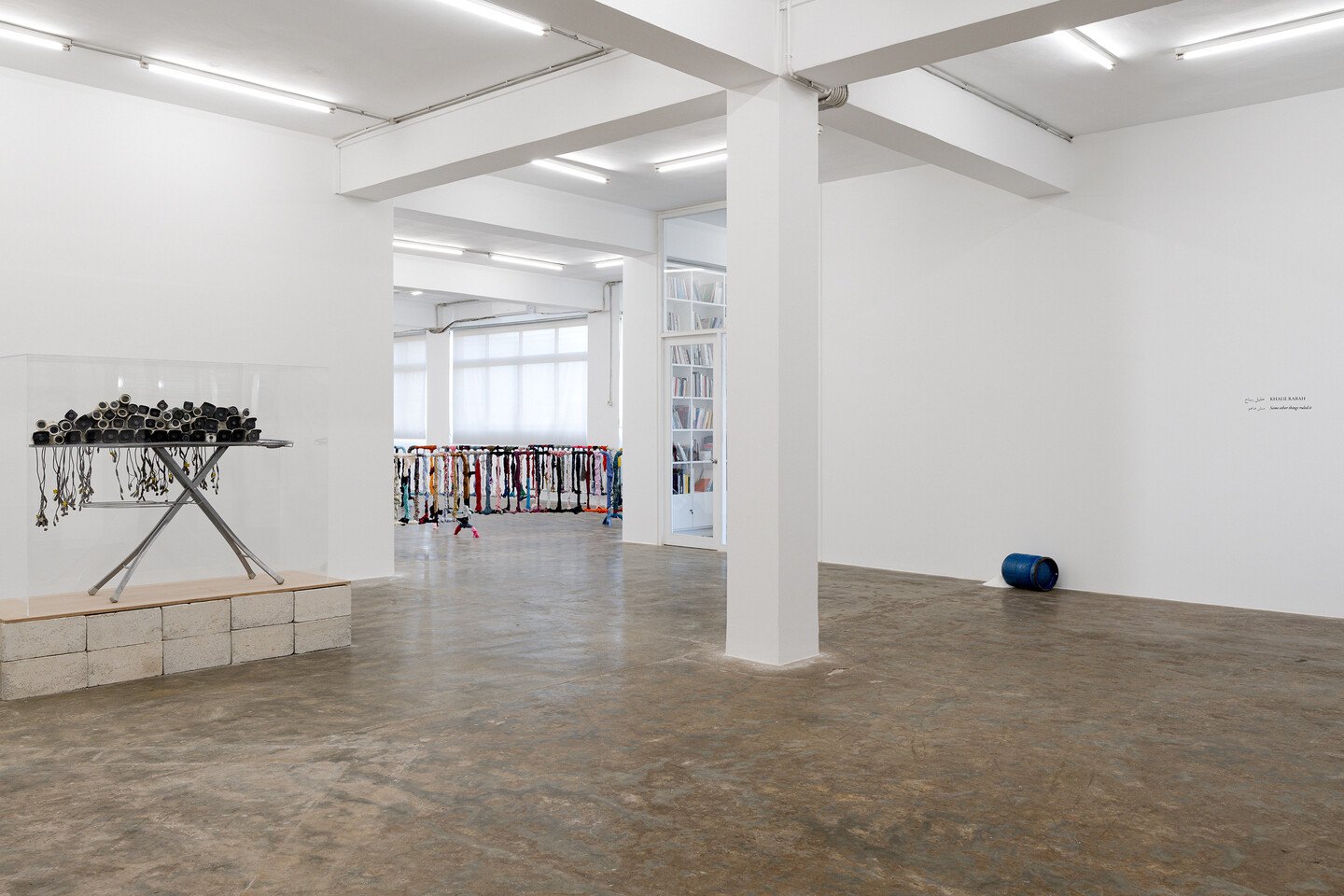
In Karantina, household and workshop objects are uprooted from their everyday use and reassembled into sculptures and installations: an ironing board carrying surveillance cameras in a plexiglass case, wooden tables weighed down with nails, rusted saws protruding from folded tarps, barbed wire wedged between gold-plated chandeliers, used bicycles lashed to a hand truck, and a greenhouse of wilting plants. Arranged across the floor, they form what the gallery describes as "a labyrinth of dead-ends and obstructions", combining the absurd with an unmistakable sense of danger.
The press text draws a line to Dada and to Marcel Duchamp's readymades, but the effect here is closer to an archive without a fixed order, in which things are continuously stacked, contained, displayed and displaced. The gallery likens the result to asemic writing: marks that look like a script and seem to carry a message, while withholding any settled meaning.
Downtown, the mood shifts to works on paper and to the materials of Palestinian life. Common threads (2025) brings together thirty worn traditional Palestinian embroidered dresses in a monumental installation honouring womanhood and motherhood, while the Testimonies series (2024) renders cut-down olive tree trunks in oil pastel, morphing them into severed limbs and amoebic shapes. Collages made with archival drafting tape and microscopes trained on tatreez needles complete a cycle of destruction and mending, which the gallery reads as "a condition of relentless reconstruction amid inexorable destruction".
Born in Jerusalem in 1961, Rabah is known for The Palestinian Museum of Natural History and Humankind, the fictional institution he has been building since 1995, and for directing the Riwaq Biennale in Ramallah since 2005. Seeing this new body of work in Beirut, a city with its own long history of rebuilding, gives the exhibition particular resonance for audiences across the region.
By