Sam Shendi
Place
Date & Time
Artists
Curators
On view · Solo exhibition
Sam Shendi
Press Release
In this current exhibition, Sam Shendi appears to be re-examining the boundaries of what he has produced throughout his artistic career. His concerns extend far beyond artistic classifications, or even the continued investment in the success of the body of work for which he has become known internationally. He is preoccupied instead with freedom, self-expression, and with connecting to both his own energy and that of the universe, embracing the overlaps and contradictions that have shaped his artistic journey, while allowing the experiences he passes through to leave their mark.
In this show, Shendi presents two bodies of work that may initially seem entirely different. On closer examination, however, they reveal themselves as two sides of the same coin.
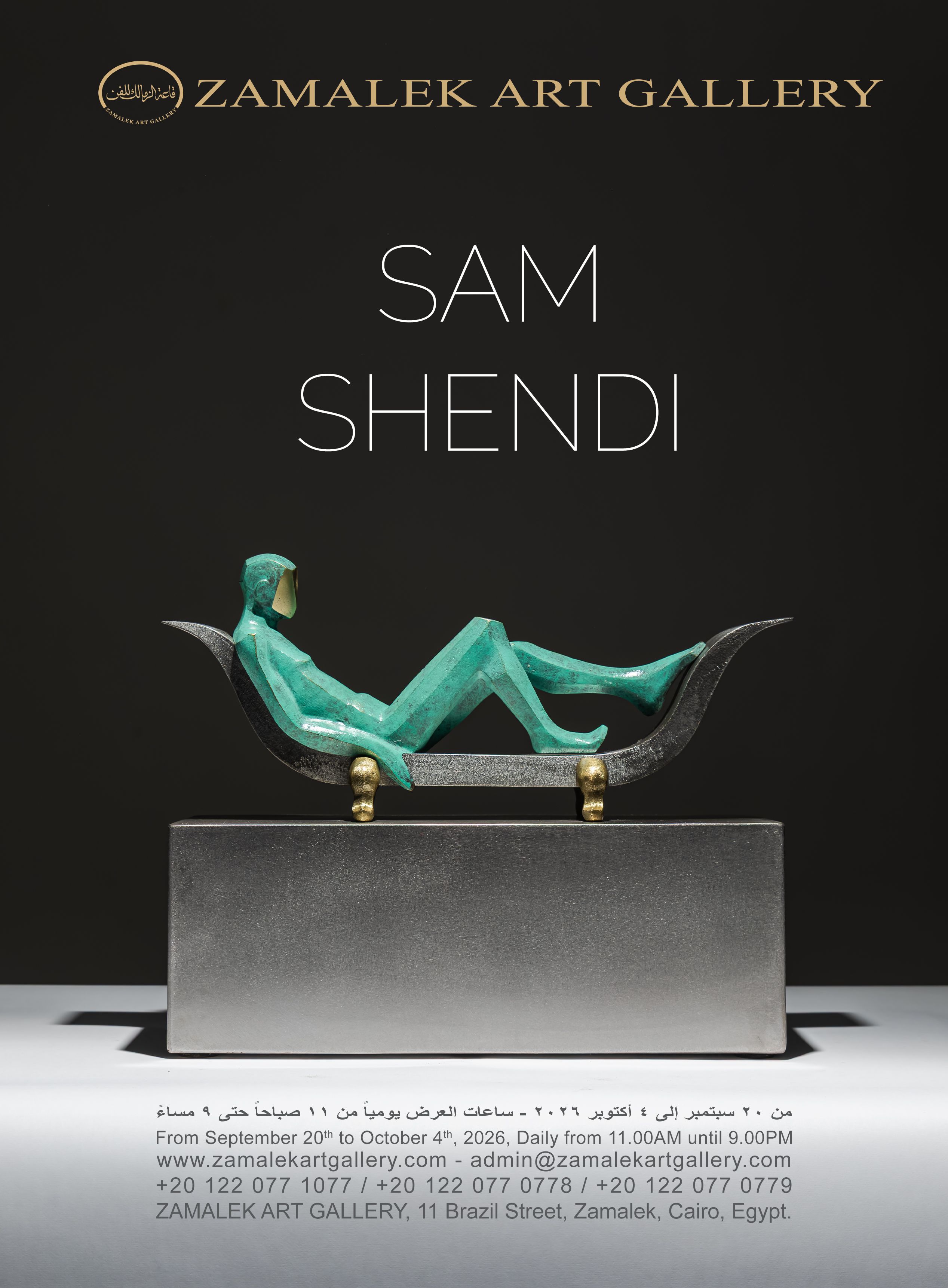
In the first exhibit, Shendi turns toward figuration, a language that is often more immediately accessible to the viewer. The human figure becomes the central presence in works that combine stainless steel and bronze. Yet, despite Shendi’s pursuit of freedom throughout both his artistic practice and his personal life, he does not grant his figures complete freedom. Instead, each exists within a binding structure that can sometimes appear to constrain them. The human being here is not so much imprisoned as restricted. One may be confined by personal beliefs and fears, another by society’s perception of them, or by prevailing ideas that limit their ability to move freely. At times, these frameworks may even represent forms of protection; structures within which the individual takes refuge, or through which they construct an image of themselves that is more acceptable to others.
These frames take on different forms and remain open to multiple interpretations. They may become shelters for individuals seeking an external source of strength with which to protect an inner fragility. This complex interaction between figures and structures raises philosophical questions about the meanings of confinement and protection, and about the subtle distinction between them. Although the figurative language of this presentation allows many of its meanings to be read with relative immediacy, Shendi succeeds in creating multiple narratives, each shaped by the viewer’s own perspective and psychological background.
The second exhibit moves toward abstraction. Here, Shendi develops the visual language of works that have gained considerable recognition in the West, releasing form from fixed boundaries through the use of tubular structures, familiar materials that he reformulates into contemporary sculptural forms. Through colour, he transforms what cannot be seen into a visual trace of movement, energy, and vibration. The viewer, in turn, is asked to free themselves from their own restrictions; including intellectual ones, in order to sense that energy. In this body of work, Shendi does not move away from the human being; rather, he approaches the human condition through a different language. If the body is at the heart of the first experience, energy becomes the focus of the second.
Seen together, the two presentations invite us into Shendi’s world and reveal the breadth of both his personality and artistic vision. This is also why one of the most significant aspects of the exhibition is his refusal to give it a specific title, as well as his decision not to title the individual works. Any title, however open-ended it may seem, gives the viewer an entry point into the work and may begin to determine what they are expected to see. Shendi deliberately leaves that door completely open. He wants the viewer to encounter the work before encountering an interpretation, and to discover independently what it awakens within them.
Between the two bodies of work, the line emerges as perhaps the most essential connection. For Shendi, the line is not simply a formal or compositional element; it represents the very beginning of creation. Before the line, there is void. With the appearance of the line, part of that void is separated and transformed into form, and this is where the creative process begins.
Even the medium becomes part of this dialogue. Bronze, with its long history and deep association with the traditions of sculpture, intersects with stainless steel and its unmistakably contemporary presence. Together, they establish a conversation between roots and openness, between what the artist carries with him from his past and what he has absorbed through years of experience in the West. Freedom, therefore, moves beyond being merely a subject within the works and becomes an active artistic practice: the freedom of the artist to leave behind the style for which he is known whenever and however he chooses; to return to his roots without becoming confined by them; and to draw from his experience in the West without allowing that experience, in turn, to become another restriction.
By Mona Abdel Karim